Dishwasher Eco vs Normal: Check Your Model Before Choosing
Choose between Eco, Normal, Auto, and other dishwasher cycles by checking your exact model guide, load, options, water, energy, and time—not the cycle name alone.
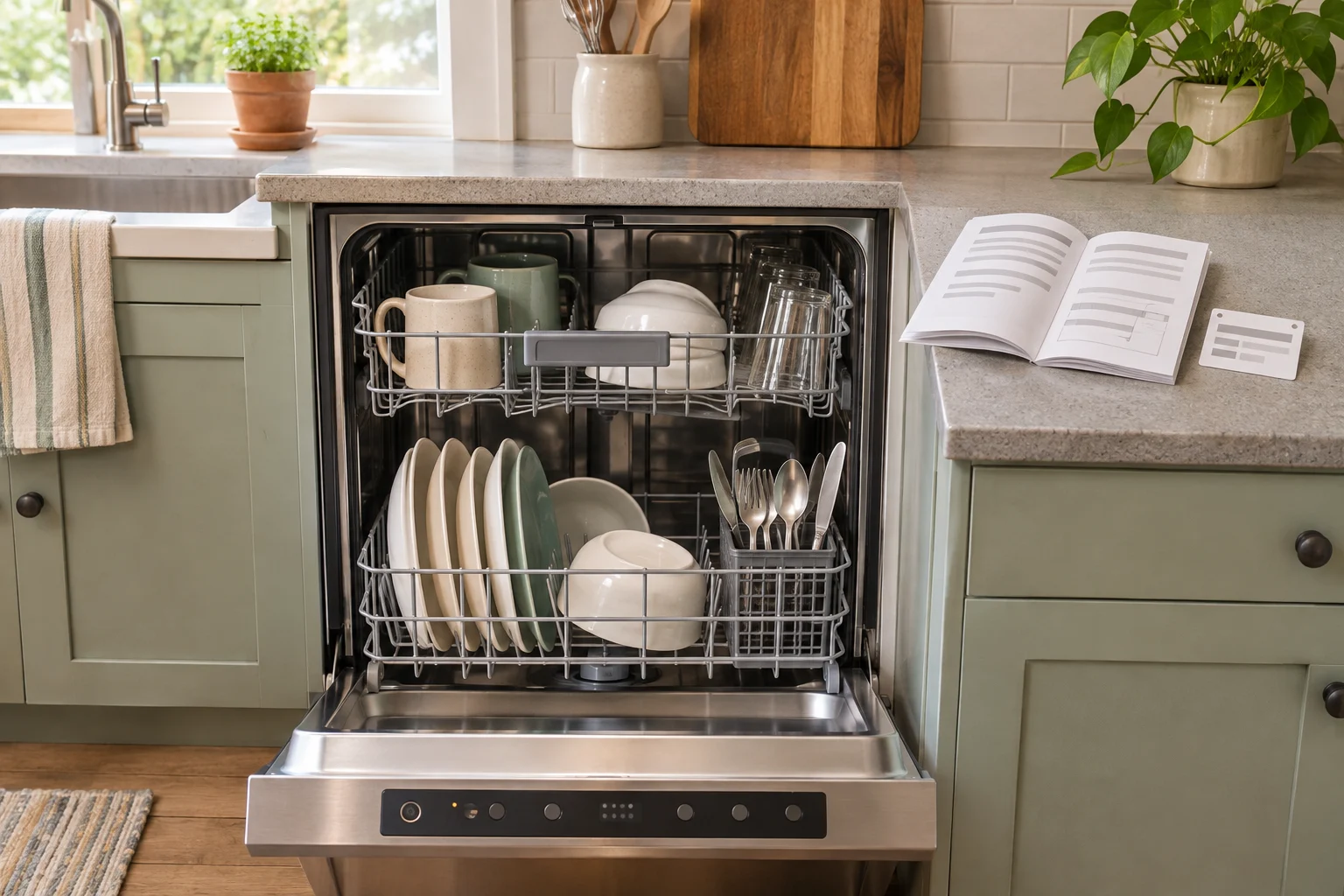
Eco and Normal are labels chosen by a manufacturer, not two standardized programs shared by every dishwasher. The useful question is not “Which name wins?” It is: Which cycle does the official guide for this exact model recommend for this load, and what do its published time, water, energy, temperature, and option notes say?
That distinction matters in the United States. One Bosch model family offers both Eco and Normal. Another Bosch model has no Eco cycle and calls Normal its most economical program. A current Whirlpool cycle guide has Sensor, Heavy, Normal, Quick Wash, and Soak & Clean—but no Eco button.
Start with the model, manual, load, and options
- Copy the complete model number. Use the rating label, purchase record, or current manual. Bosch's US manual finder searches by the rating-plate model number; Whirlpool's manual search also requires the model number.
- Open the official cycle guide for that exact model. Similar-looking control panels can have different cycles, defaults, temperatures, and options.
- Describe the load honestly. Note ordinary mixed dishes, lightly soiled glassware, baked-on cookware, delicate items, or a task that specifically requires a sanitizing option.
- Read the whole row, not just the cycle name. Check time, water, electrical energy if published, wash and rinse temperature, drying behavior, detergent notes, and whether the values are fixed or sensor-controlled ranges.
- Add the selected options. Heated dry, sanitize, high temperature, extra shine, half load, and other options can change time and resource use.
| What the exact guide shows | Reasonable starting use | What to verify before pressing Start |
|---|---|---|
| Eco | Only the loads and soil level the maker assigns to Eco. | Published time, water, energy, temperatures, drying, unavailable options, and whether the figures are ranges. |
| Normal or Regular | The maker's stated daily, regular, or typical load. In the US, this is often the certification cycle. | Required load/soil, tested drying option, sensor behavior, and whether another cycle is recommended for heavy, delicate, or sanitizing needs. |
| Auto or Sensor | Mixed loads when the maker says sensing can adapt to soil. | The possible range, default options, and the manual's warning that real time and use change with soil, temperature, and installation. |
| Heavy, Pots & Pans, or Sanitize | Only a load or outcome that the guide assigns to that cycle or option. | Item compatibility, higher temperatures, extra detergent instructions, completion indicator, and changed energy/water/time. |
| Quick or Express | The light-soil or time-sensitive load the maker describes. | Cleaning and drying limits. Shorter time does not prove lower energy or water. |
Three official US examples show why the label is not enough
| Official document | Eco | Normal | What the comparison proves |
|---|---|---|---|
| Bosch SPE68U55UC, SPV68U53UC, and SPX68U55UC manual 9001388901_B | 75–85 minutes; 2.2–3.5 gal; 113–122°F wash | 130–135 minutes; 2.2–4.3 gal; 122–131°F wash | Both labels exist, their water ranges overlap, and Eco is not longer in this example. |
| Bosch SPE68B55UC manual 9001631730_A | No Eco row in the published cycle table | “Most economical”; 2:10–2:15; 0.620–0.660 kWh; 2.7–4.6 gal | A US dishwasher can use Normal as its economical cycle rather than offering Eco. |
| Whirlpool cycle guide W11419581 Rev C | No Eco cycle shown; Sensor is a separate adaptive cycle | Recommended for a full, normally soiled daily load; certification based on Normal with Heated Dry | Cycle availability and the certified option combination must come from the applicable guide. |
Sources: Bosch manual 9001388901_B, Bosch SPE68B55UC manual, and Whirlpool cycle guide W11419581 Rev C.
These are documentation examples, not a product ranking. The older Bosch family illustrates a real Eco/Normal table; the newer documents show that US naming and certification guidance differ. Their numbers cannot predict another dishwasher, a different option combination, local utility cost, or the result on your dishes.
What Normal means in US efficiency testing
The US Department of Energy dishwasher test procedure defines the normal cycle around the cycle type and temperature options that the manufacturer recommends for daily, regular, or typical use to completely wash a full load of normally soiled dishes. If more than one cycle is recommended under the rule's conditions, its selection rules apply. This is why a US manual may identify Normal—not Eco—as the certification or economical route.
ENERGY STAR's current dishwasher criteria compare annual energy and per-cycle water under the DOE method. Standard-size certified models must meet the current program limits, but those product-level figures do not tell you that every button named Eco beats every Normal cycle for every load.
Choose the cycle by the result you need
- For an ordinary full load, start with the maker's daily or typical recommendation.
- For baked-on cookware, use the heavy-soil route only if the manual assigns it to that job.
- For delicate or temperature-sensitive items, confirm both dishwasher safety and the permitted cycle or rack.
- For sanitizing, use only the documented cycle/option and verify its completion indicator or other manual requirement. Normal and Eco names do not prove a sanitizing result.
- If dishes emerge dirty or wet, check loading, blocked spray arms, filter care, detergent, rinse aid, incoming-water guidance, and selected options in the manual before assuming another cycle name is always the answer.
ENERGY STAR's dishwasher guidance recommends scraping rather than pre-rinsing and running suitable full loads when possible. Apply those practices only with the loading and item-care directions for your machine and dishware.
For an appliance-purchase comparison, use the EnergyGuide and capacity method. For choosing cleaning products around appliance surfaces, use the surface-and-job guide.
Research note, 18 November 2026: this guide compares official US agency guidance and three manufacturer documents. We did not operate or meter a dishwasher, test a load, verify sanitization, compare detergent, measure water or electricity, or calculate household savings. The cover is generated editorial art and does not depict a tested appliance or readable model.
Frequently Asked Questions
Is Eco always cheaper to run than Normal?
Do not assume so from the name. Check the exact model's cycle table, selected options, and your utility rates. Some manuals publish ranges that overlap, while some US models have no Eco cycle and identify Normal as the economical or certification cycle.
Why can a dishwasher's efficient cycle take longer?
Time alone does not measure energy or water. A program may trade heating intensity, water changes, spray behavior, sensing, or drying for time, but the design is model-specific. One official Bosch example even lists Eco as shorter than Normal, showing why a universal longer-Eco rule is unsafe.
Is the Normal cycle the government test cycle in the United States?
DOE's test procedure defines a normal cycle around the maker's daily or typical recommendation for a full normally soiled load, with specified option rules. A manufacturer's guide may state the exact cycle and options used for its certification. That does not make every cycle named Normal identical across models.
Does Normal or Eco sanitize dishes?
A cycle name alone does not prove sanitization. Use only a cycle and option whose manual says it meets the applicable sanitization requirements, and follow its loading, water-temperature, and completion-indicator instructions.
How do I find the correct dishwasher manual?
Copy the complete model number from the appliance's rating label, purchase record, or existing manual, then use the manufacturer's official owner-support search. Do not rely on a manual for a similar-looking model or on the control-panel name alone.
Earth Friendly Blogs Editorial Team
Research & Editorial
We turn trusted guidance and practical research into clear, approachable steps for a lower-waste home. Every guide is reviewed for usefulness, accuracy, and honest limitations before publication. Our editorial approach →